Clarisse Strub
The Master Butchers Singing ClubClarisse Strub is the prospective heir to Argus’s most respected funeral practice, an accomplished mortuary assistant whose care for the dead coexists with a lifelong love of theater and disguise. Her bond with Delphine Watzka begins in childhood and endures through illness, loss, and danger; when Sheriff Hock’s pursuit turns into a threat inside Clarisse’s home, she kills him and vanishes. Her story joins the discipline of her profession to the theatricality that has always offered her another role—and ends with the town left to speculate about the woman who escaped it.
Identity and Background
Clarisse is the young niece and apprentice of Aurelius Strub, Argus’s funeral director and mortician, and stands to inherit Strub’s Funerary. The practice is described as the most advanced and well-regarded in that part of the state. Its reputation extends beyond Argus: families from more distant towns seek the Strubs’ work, reassured by the composure of the bodies they prepare and display. Clarisse is not merely expected to take over a business; she is trained in a craft that gives the town’s dead a carefully managed passage into burial.
Her aptitude is apparent early. In school she earns top marks dissecting a flatworm, and she learns the practical arts of embalming under her aunt Benta’s supervision. Her work places her near bodies before she has formally inherited the profession. A secret infection interrupts the bright confidence associated with her, and she undergoes prolonged treatment overseen by Doctor Heech. Delphine alone, apart from Clarisse’s family, knows what happened and is admitted to the private basement of the funeral home. The episode establishes both the intimacy of their friendship and the discretion surrounding Clarisse’s life.
Theater, Friendship, and the Funeral Home
Before work and family duty narrowed her choices, Clarisse and Delphine made elaborate performances together. Their shared love of disguises brought them together in grade school: in Clarisse’s backyard they used a sheet as a curtain, changed costumes between parts, and lit their makeshift stage with an old captain’s lamp. Other children treated them with a mixture of mockery and admiration. Their loyalty helped them withstand the teasing until the town began to accept—and even value—their eccentric performances.
Both girls imagined leaving Argus for cities and real theaters. Delphine briefly pursued that dream as part of Cyprian Lazarre’s act, but Clarisse remained behind when her family required her in the business after high school. After her parents’ deaths, schooling and amateur drama gave way to work. She accepts this future, while recognizing its cost: she has a natural aptitude for embalming, but that aptitude binds her to Argus and to the dead. The funeral home’s carefully regulated basement becomes the place where her vocation and her friendship meet. Delphine is allowed inside where almost no one else may go, and, in a later crisis, trusts the room as a private place to speak freely.
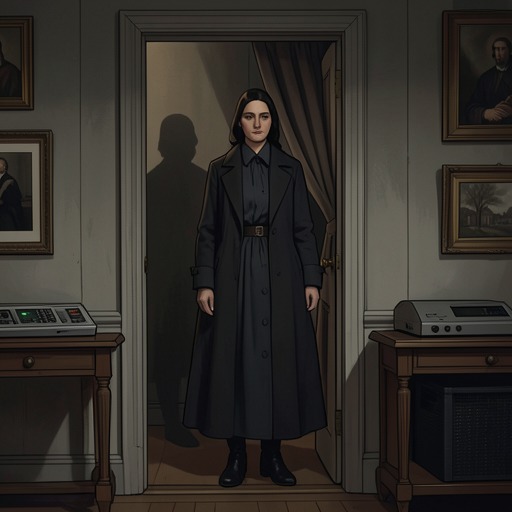
The theater does not disappear from Clarisse’s adult life; it changes its setting. She and Delphine still recall performances, and Clarisse can slip into a theatrical mask even in the midst of serious work. She once played a witch opposite Delphine in Macbeth, and their old lines return when they meet during the removal of bodies. Her professional clothes and equipment—white gown, mask, rubber gloves, and smoked glasses—can obscure her face, but her distinctive curly black hair gives her away. The contrast is telling: she performs a solemn duty before the dead, yet remains the same inventive companion who once turned a backyard into a stage.
Work, Independence, and Hock’s Pursuit
Clarisse’s care for the deceased is exacting. She dresses with an elegance she considers appropriate to the occasion and takes pride in presenting the dead as honored guests rather than as objects of a trade. After preparing a man who drowned, she is satisfied that she has reduced the visible effects of death. She recalls a poorly handled funeral elsewhere as a failure of care toward the bereaved family, and declines an offer of extra payment after the family thanks the Strubs. Her standards make the work a form of service as well as a technical craft.
Outside the funeral home, Clarisse maintains her own household and habits. She inherits her parents’ house, cooks elaborate meals in her mother’s kitchen, and is particular about what she eats. When Delphine begins working at Waldvogel’s Meats, Clarisse moves her grocery trade there; Delphine saves the leanest cuts for her. Their friendship is sustained through ordinary exchanges—food, clothing, visits—as well as through the more extraordinary secrets they keep for one another.
Sheriff Hock’s attention makes Clarisse’s independence precarious. He presents himself as bound to his public role and says that taking another part in theater would confuse the town, yet asks Delphine about Clarisse and speaks of her as if their future together were inevitable. Clarisse, by contrast, is avoiding him. She tells Delphine that a prospective suitor rejected her because of her work, resenting the assumption that she should abandon her profession to make herself acceptable. Her humor about men’s fear of the funeral home’s basement does not erase the limits placed on her: her vocation unsettles potential partners, while Hock treats her refusal as an obstacle rather than a decision.
The Search, the Killing, and Flight
The danger sharpens when evidence connected with the red, beaded costume Clarisse wore to a wake appears in the sealing material on Delphine’s cellar door. Delphine recognizes beads like those on the dress and warns Clarisse that Hock may be forming suspicions. Clarisse is distressed: Hock had pulled at the dress that night, and she knows it could draw attention to her. Delphine hides the costume in an iris patch, an act Clarisse later thanks her for. Their exchange makes the dress more than theatrical finery: Clarisse remembers wearing it beneath a black coat at her father’s wake, where it gave her courage to face his death.
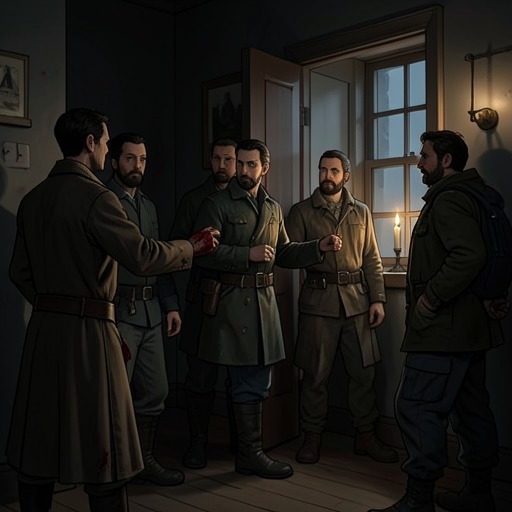
Hock eventually obtains a warrant to search Clarisse’s house. His meticulous inspection of the floorboards reflects his determination to find a red glass bead; the search brings his authority directly into her private home. Clarisse warns him to leave and keeps a knife behind her back. When he refuses and advances, she uses it to kill him. The account presents her thoughts as controlled and practical in the crisis, not as a prolonged declaration or a planned public act. The decisive change is from a woman being watched and pursued to one who acts to stop the immediate threat.
Disappearance and Narrative Significance
In the days after Hock’s death, the town’s attention fixates on the case, but no explanation resolves Clarisse’s disappearance. His body is taken to the coroner in Fargo, his house is secured, and ordinary life gradually resumes around the event. Clarisse leaves openly by train with a red hatbox and brown suitcase. The town’s later account supposes that she got off in Minneapolis, changed trains and names, and remade her life, but no one sees her again and she is never captured. Those possibilities remain speculation rather than confirmed details of her destination.
Delphine does not volunteer what she knows about Clarisse’s last movements. Their shared history gives her silence a particular weight: she and Clarisse had been the strange girls who endured the town together, and Delphine had hidden the dress and stood by her friend when suspicion gathered. After Clarisse is gone, Delphine misses her as a constant absence that makes work harder and loneliness more distracting. Visits with Aurelius and Benta do not replace the friendship. She turns to reading when she wants to talk to Clarisse, registering the loss as another opening through which someone beloved has disappeared from her life.
Clarisse’s arc is shaped by a double vocation. She prepares others for burial with precision and composure, while theater offers a history of invention, disguise, and imagined escape. The final disappearance fuses those strands without resolving them: the woman who once hoped to leave Argus for a stage finally leaves under the pressure of violence, and the town’s gossip cannot restore her to view. Her absence remains part of Delphine’s life as surely as her work once belonged to the funeral home.